
Fuel prices have become one of the biggest motoring talking points in Northern Ireland this year. Even when prices ease slightly week to week, the wider pressure remains. Every fill-up is noticed more, every regular journey feels more expensive, and the cost of staying on the road has become harder to ignore.
But the real impact of higher fuel costs is not always as simple as people driving less.
In practice, many drivers across Northern Ireland still need their car for work, school runs, shopping, appointments and everyday life. In many areas, driving is not a luxury. It is how people stay mobile. That means higher fuel costs do not always remove journeys — they often just force sacrifices somewhere else.
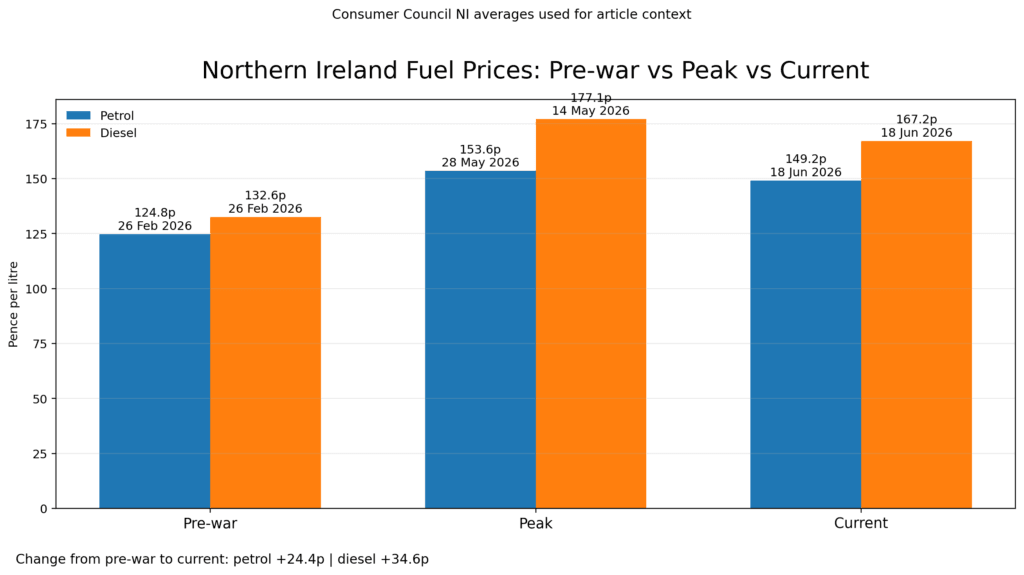
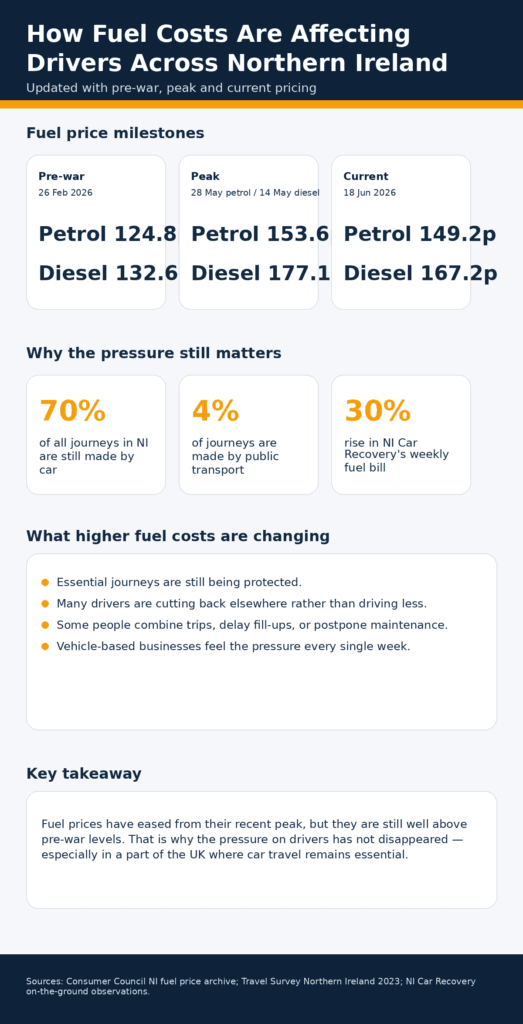
Current Northern Ireland fuel figures reflect that pressure. According to the Consumer Council fuel checker, show the average price on 18 June 2026 was 149.2p for petrol and 167.2p for diesel, down from 150.6p and 169.3p a week earlier. Even with that slight drop, the cost of keeping a vehicle on the road remains a major issue for many households and businesses.
What makes this story more interesting is that higher fuel costs do not always lead to a simple reduction in driving. Recent Belfast Telegraph reporting suggests many motorists are still trying to protect essential journeys, even if that means cutting back elsewhere. In other words, the financial strain is real, but mobility is still being prioritised.
That makes sense in Northern Ireland, where the car still plays a central role in daily life. Official travel data shows that 70% of all journeys here are made by car, while public transport accounts for only a small share. For many households, especially outside the best-connected urban areas, driving is still the only realistic way to stay mobile.
Northern Ireland is still heavily dependent on the car
For all the talk about changing travel habits, Northern Ireland remains strongly car-dependent. For many households, especially outside the most connected urban areas, there is no realistic alternative to driving for a large share of everyday journeys.
That changes how fuel price rises are felt. In places where people can easily switch to trains, trams or frequent bus networks, higher fuel prices may lead to a clearer drop in car use. In Northern Ireland, the picture is often different. Drivers may cut some journeys, combine errands into one trip, or think twice before heading out unnecessarily — but many still need to keep the car moving.
So while rising fuel prices can change behaviour, they do not automatically mean less mobility. In many cases, they simply make essential mobility more expensive.
The pressure is real — but it does not always show up as fewer journeys
There has certainly been pressure on drivers. Some are reducing non-essential trips. Some are watching the fuel gauge more closely. Others are changing how and when they travel.
But there is another side to this story too.
A lot of drivers are protecting mobility by cutting back elsewhere. Instead of parking the car completely, they are absorbing the cost in other parts of life. That may mean less discretionary spending, fewer extras, or tighter household budgeting in general.
From a car recovery point of view, that rings true. At NI Car Recovery, we have not seen a meaningful drop in recovery demand that would suggest drivers are coming off the road in large numbers. Cars are still being used, people are still relying on them, and mobility is still being protected. The clearest impact at our end is cost: our own weekly fuel bill is up by around 30%.
That is an important real-world point. Higher fuel prices may be hurting drivers and businesses, but they are not necessarily taking vehicles off Northern Ireland’s roads in the way some people might assume.
What higher fuel costs are changing for drivers
Even where mobility stays broadly intact, fuel pressure can still change behaviour in smaller but important ways.
- Drivers may delay non-essential trips
A run that once felt easy or spontaneous may now be postponed, combined with another errand, or skipped altogether unless it feels worth the fuel.
- People may try to stretch a tank further
This can show up in more cautious driving, later fill-ups, or waiting longer before refuelling. In some cases, drivers push their luck too far and end up running very low.
- Household budgets become tighter
For some, the real cost of higher fuel is not fewer journeys but more financial strain elsewhere. If staying mobile is non-negotiable, something else often has to give.
- Maintenance can be pushed down the list
When running costs rise, it becomes easier for routine checks, tyre replacement, servicing or minor repairs to be delayed. That does not save money forever — it often just delays the spend.
- Businesses feel it too
Trades, delivery drivers, recovery operators and any business with vehicles on the road feel the effect directly. Fuel is not a background cost when a vehicle is constantly moving. It becomes a weekly pressure point.
Why this matters from a breakdown and recovery perspective
From a breakdown and recovery point of view, the most interesting thing is not just what drivers are spending — it is how they respond.
When costs rise, some drivers become more cautious and organised. Others do the opposite. They may put off replacing tyres, delay servicing, keep driving with warning signs, or leave less margin in the tank than they normally would.
That does not mean fuel prices directly cause breakdowns. But financial pressure can influence the decisions that shape vehicle reliability.
A driver who is already watching every pound may be more likely to delay a battery replacement, postpone getting a tyre checked, ignore a minor warning light for longer, or continue using a vehicle that is overdue attention.
That kind of pressure does not always show up in a headline, but it does matter in day-to-day motoring reality.
Are people really driving less?
To some extent, yes — particularly for optional or easily delayed trips.
But the bigger picture in Northern Ireland is more nuanced than that. A lot of journeys are not easy to remove. Work still has to be reached. Children still need collected. Shopping still has to be done. Families still need to get around. Businesses still have to operate.
So the more accurate reading is probably this:
Higher fuel costs are making driving harder and more expensive, but not necessarily less necessary.
That helps explain why many drivers feel under pressure without there being a dramatic collapse in road use. It also explains why businesses that rely on vehicle movement, including recovery operators, can feel the cost impact strongly even while demand remains steady.
The cost of staying mobile in Northern Ireland
In some parts of the UK, conversations about fuel often focus on cutting leisure drives or choosing public transport instead. In Northern Ireland, that does not always reflect how people actually live.
For many households, the car is tied directly to basic mobility. It is not just for convenience. It is often the practical link to work, schools, shops, healthcare and family responsibilities.
That is why rising fuel prices can hit differently here. They do not just make driving more expensive. They make everyday life more expensive.
And that is why the story is not simply about whether people are driving less. It is also about what people are giving up in order to keep driving.
What drivers can do without creating bigger problems later
When fuel costs rise, it makes sense to look for savings. But there is a difference between sensible efficiencies and false economy.
Some practical ways to reduce pressure without increasing breakdown risk include:
- keeping tyres at the correct pressure
- avoiding unnecessary weight in the car
- combining journeys where possible
- not leaving fuel dangerously low
- and staying on top of obvious maintenance issues before they become bigger ones
Trying to save money by postponing every spend linked to the car can backfire if it leads to a larger repair bill or roadside problem later on.
The real impact of higher fuel costs
The real impact of higher fuel costs in Northern Ireland is not just visible at the pump.
It shows up in tighter budgets.
In harder decisions.
In people protecting essential journeys and trimming elsewhere.
In businesses absorbing higher running costs week after week.
And in the reality that, for many drivers here, staying mobile still comes first.
That is why fuel pressure is such an important motoring issue. It is not simply about whether people are travelling less. It is about what it now costs them to keep travelling at all.
How This Guide Was Compiled
This guide was put together using current Northern Ireland fuel-price reporting, wider local coverage on the effect of rising fuel costs, and real day-to-day observations from roadside recovery work. It is intended to reflect the practical reality facing drivers across Belfast and Northern Ireland, rather than offering generic commentary on fuel markets in isolation.
If you would like to read more about our roadside support and vehicle recovery coverage, you can find full details on our car recovery in Belfast page.