
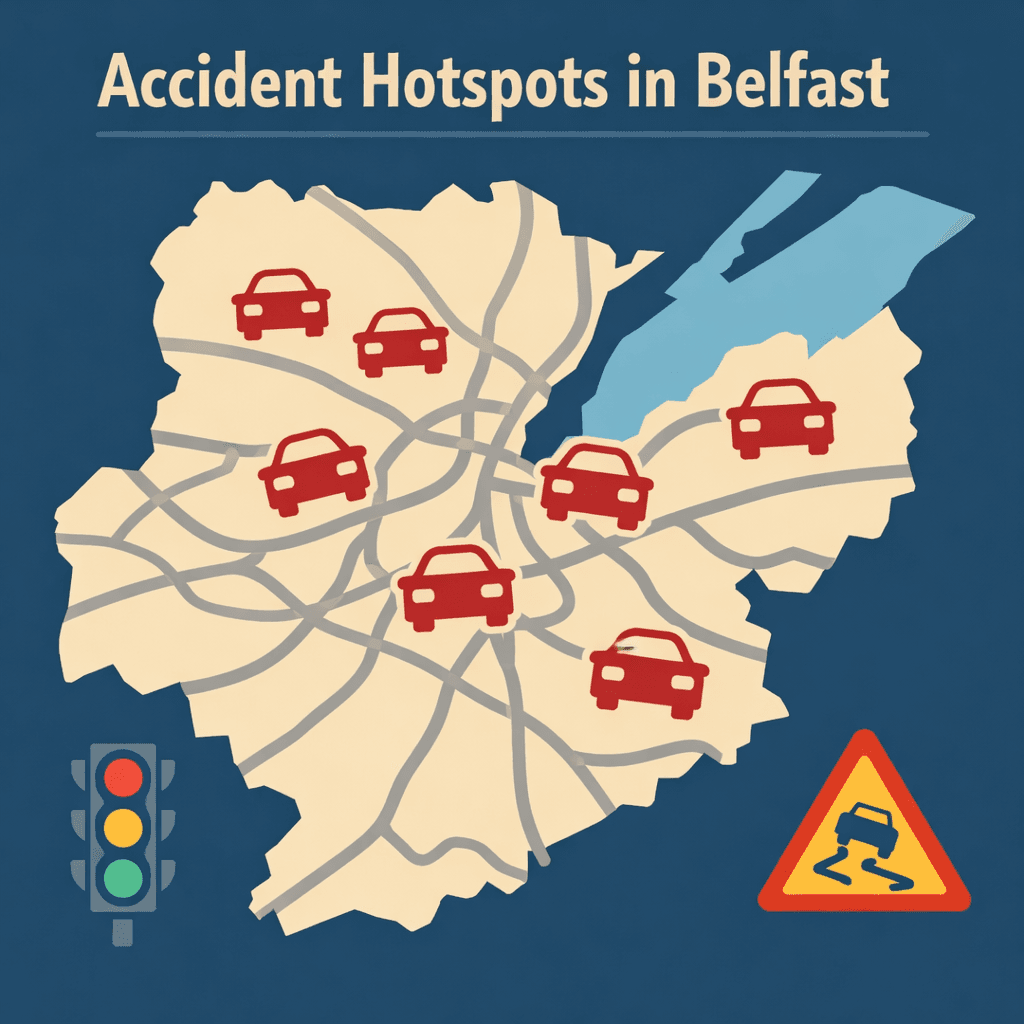
Where Collisions Most Commonly Occur (and Why)
Across Belfast, the same junctions, road layouts, and traffic conditions consistently appear when collisions occur. Over time, clear patterns emerge — shaped by congestion, visibility, road design, and driver behaviour rather than isolated mistakes.
This page exists to document where accidents most commonly happen in Belfast, why those locations are higher risk, and what drivers should realistically expect after a collision.
It’s about real-world patterns observed repeatedly on the ground by experienced local operators such as NI Car Recovery.
Why Accident Hotspots Exist in Belfast
Belfast’s road network creates several conditions that naturally increase collision risk:
- Heavy congestion feeding into tight junctions like the bottom of Newtownards Road.
- Sudden lane merges and short slip roads like the M3 bridge heading out of Belfast.
- Urban roads transitioning quickly into faster routes
- Poor visibility at older junction layouts
- Wet road surfaces and frequent weather changes
When these factors combine, even minor errors can result in collisions — particularly at peak times.
Common Types of Accident Hotspots Across Belfast
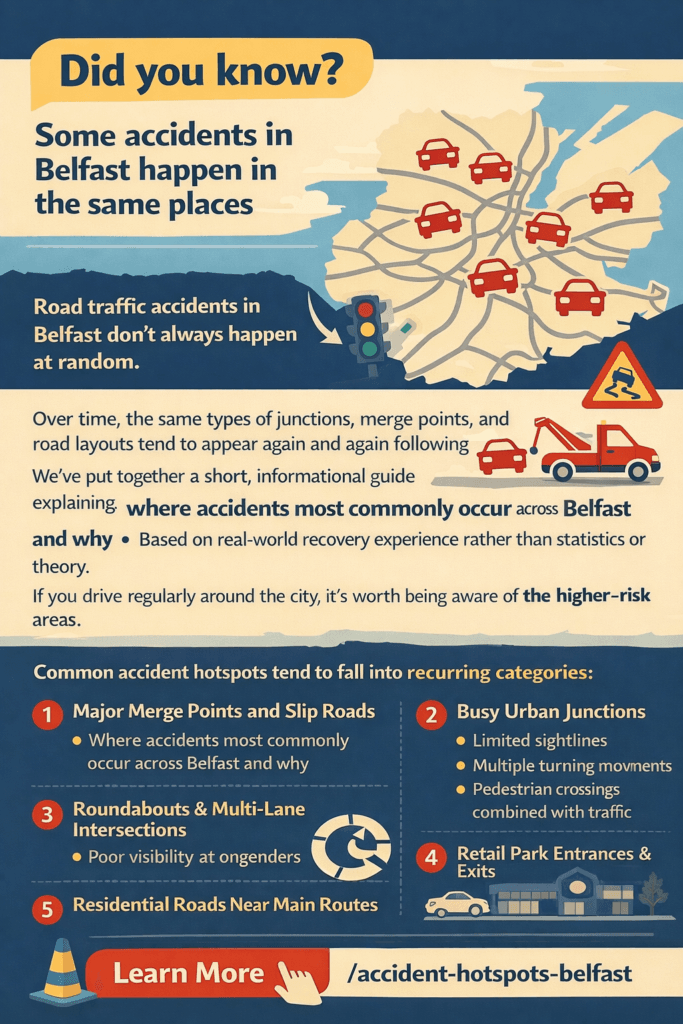
Rather than isolated locations, accident hotspots tend to fall into recurring categories.
- Major Merge Points and Slip Roads like the Westlink.
- Belfast city centre.
- Areas where traffic accelerates, slows, or merges are among the most collision-prone, Upper Malone and Lisburn Road are hot areas for this.
- Typical issues include:
- Sudden braking
- Lane-change misjudgements
- Rear-end collisions during congestion
- Side impacts during merges
These incidents often occur at relatively low speeds but still leave vehicles undriveable.
Busy Urban Junctions
Older junction layouts across Belfast were not designed for modern traffic volumes.
Common contributing factors:
- Limited sightlines
- Multiple turning movements
- Pedestrian crossings combined with traffic flow
- Driver hesitation or late decisions
- Low-speed collisions are common here, but damage is often enough to prevent vehicles being driven away.
Roundabouts and Multi-Lane Intersections
Roundabouts are designed to keep traffic moving — but confusion increases collision risk.
Typical problems include:
- Failure to give way
- Incorrect lane choice.
- Side-swipe damage
- Misjudged exits
These collisions frequently block lanes and require recovery rather than roadside fixes.
Retail Park Entrances and Exits
Some of the most underestimated accident hotspots are around large retail areas like Forest Side shopping centre and the Kennedy centre.
Common scenarios:
- Vehicles pulling out into fast-moving traffic
- Reduced visibility due to parked vehicles
- Pedestrian distraction
- Stop-start congestion during busy periods
Accidents here are often unexpected and disruptive, particularly at weekends.
Residential Roads Near Main Routes
Collisions don’t only happen on major roads.
- In residential areas close to main routes:
- Speed differences between local and through traffic increase risk
- Parked vehicles reduce visibility
- Junctions onto main roads create pressure points
These incidents often occur close to home — adding to the stress and disruption involved.
Timing Patterns: When Accidents Are More Likely
Accident callouts across Belfast tend to cluster around predictable times:
- Morning and evening rush hours
- Wet or icy weather conditions
- Dark winter evenings
- Fridays, when traffic patterns change
These patterns reinforce that environment and timing matter as much as driver behaviour.
What Typically Happens After a Collision
Following a collision, vehicles are often:
- Unsafe to drive
- Mechanically damaged
- Blocking traffic or junctions
- Even low-speed impacts can:
- Damage steering or suspension
- Trigger warning systems
- Cause fluid leaks
In many cases, recovery rather than roadside assistance is required to clear the scene safely.
Why Accident Recovery Differs from Breakdown Recovery
Accident-related recovery involves different considerations:
- Vehicle condition may be unpredictable
- Damage may not be immediately visible
- Safety and clearance take priority over diagnosis
This is why accident recovery is treated as a distinct service, separate from standard breakdowns.
What Drivers Should Do After an Accident in a High-Risk Area
If a collision occurs:
- Move to a safe position if possible
- Avoid attempting to drive a damaged vehicle
- Prioritise safety and traffic clearance
- Arrange appropriate recovery rather than repeated movement
Attempting to “limp” a damaged vehicle away often causes further issues.